
A director at an industrial distributor told me he wanted to switch Meta Ads providers. He'd been paying for a year and was unhappy. I asked when the new one could start. "That's the catch," he said. "The campaigns, the pixel and the ad account are all in their name. If I leave, I'm left with nothing, not even the history."
It happens a lot. And it was almost always avoidable with four questions asked before signing. This is the list of what I'd ask of whoever runs Meta Ads for your company, and what I'd ask them. It works the same whether you're about to hire, already have someone, or run it with your own team.
1. The ad account in your name
The ad account must live inside your Meta business portfolio (what used to be called Business Manager), with your company as the owner. Whoever provides the service joins as a partner with the permissions they need, and those can be removed when the relationship ends.
The opposite, where you enter their account as a guest, seems more convenient at first and leaves you tied down later.
Ask: "Will the ad account and the company page be in my portfolio? Who will be an admin besides you?" You should always hold full admin rights. If they say "it's not necessary," you have your answer.
2. The pixel and the data are yours
The Meta pixel (and the Conversions API that complements it) collects what your visitors do: who arrived, who filled out a form, who messaged on WhatsApp. Over time, that information makes the ads more precise. It's an asset of your company, built over months.
If the pixel sits in another company's portfolio, that learning stays there when you leave, and you start from zero.
Ask: "Will you create the dataset and the pixel in my account? Who holds the website access needed to install it?"
3. A contact report, not a reach report
Reports built on reach, impressions and clicks look good and almost never tell you whether the money worked. Reach means someone saw the ad, not that they were interested.
What you should ask for every month:
| What usually arrives | What you should ask for |
|---|---|
| Reach and impressions | Contacts received (forms, WhatsApp, calls) |
| Ad clicks | Cost per contact |
| Post interactions | How many contacts were real prospects |
| A 20-page PDF | One sheet with 5 numbers and what you changed |
And the question that puts everything in order: how many of those contacts ended in a sale or a quote? Someone who only sees Meta can't know that. It has to be matched with your side: who called, who got a quote, who bought. If your provider says that "isn't their responsibility," at least ask them to let you connect the data so you can do it. More on this in why your agency isn't delivering ROI.
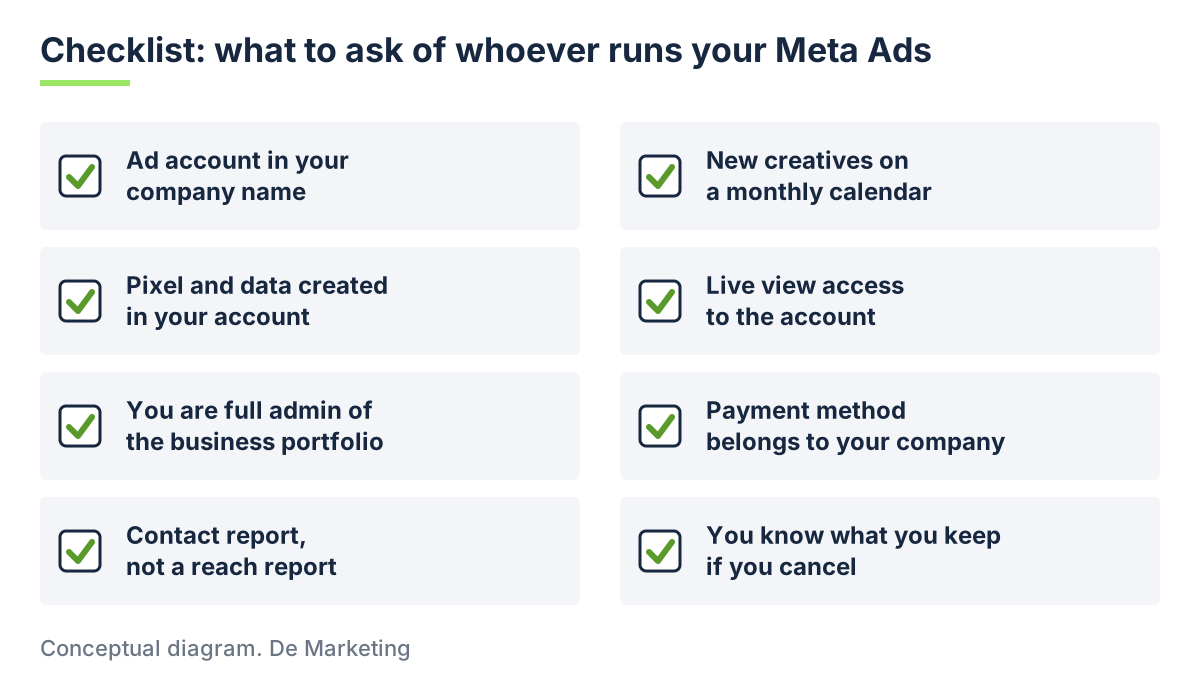 An 8-point checklist before hiring or renewing Meta Ads.
4. Creatives that rotate, on a calendar
On Meta, an ad wears out. The same people see it again and again, frequency rises, and cost per contact rises with it. This is called creative fatigue.
Most performance problems after a few weeks are fixed with new material, not more budget.
Ask for:
- A calendar of new creatives with a clear cadence: how many new pieces per month and of what type (image, short video, testimonial).
- Tests of different ideas, not just the same design in another color.
- A simple note each month: what was tested, what won, and what gets dropped.
Ask: "Who makes the ads, you or me? How often are they renewed?" If the answer is "the ones you send us," be ready to review yours every month.
5. Live access and no surprises
You shouldn't learn how your spend is going once a month by email. Ask for view access to the account, or a dashboard that updates itself, so you can see how much was spent and how many contacts arrived at any moment.
Also be clear on how the advertising is paid. The healthiest setup: the card or payment method belongs to your company, and the fees of whoever serves you are billed separately. That way you see exactly how much goes to Meta and how much to the service.
6. Questions that reveal how they work
Beyond the above, these questions tell you a lot in a twenty-minute conversation:
- What do you do if there are no good contacts in two weeks?
- How do you separate someone asking for information out of curiosity from someone who will actually buy?
- Which campaign objective will you start with, and why?
- What do you need from my team for this to work? (an honest answer includes responding quickly to contacts)
- If I cancel, what do I take with me?
The last one is the most revealing. Someone who works well explains the exit without embarrassment.
What's on your side of the table
A good provider doesn't fix everything alone. There's a part that belongs to your company, and it's better to say so from the start so nobody gets surprises:
- Answer fast. A contact that arrives through Meta and waits a day for a reply goes cold. Someone must handle messages and calls the same day.
- Say which contacts were good. Without that data, whoever runs the campaigns can't teach Meta to find similar people.
- Share real information about the business. Which service leaves the most margin, which areas you serve, what kind of customer you don't want. That's how targeting gets adjusted.
- Give it time. Meta needs a few weeks to learn. Anyone who asks you to decide everything in the first week is asking you to judge a film from one frame.
If both sides do their part, the relationship works. If one fails, the contact report will show it quickly.
When to worry
There are signs that don't require waiting three months:
- They promise fixed results ("I guarantee 100 leads a month"). Nobody controls Meta's auction.
- They won't give access to the account "for security."
- They talk about followers and likes when you want sales.
- The reports change format every month.
To set this against other decisions when choosing a provider, you have this guide to choosing a digital marketing agency in Mexico and the comparison against a traditional agency. And to understand what to expect from the platform itself, Meta Ads for companies in Mexico.
How we do it
At De Marketing we are the digital marketing department of our clients, and we run it with the Sísmico Method: four steps so you know where each sale comes from. On Meta that translates into what you just read: the account and the pixel are in your name, the report talks about contacts, and creatives are renewed on a calendar.
If you already have someone running your Meta Ads and want to know how many of these eight points they meet, book a Levantamiento. We'll review it together with your account open.
Related services
Want to implement this in your company?
Leave your website and within minutes you'll get a reading of your marketing by email: step 1 of the Método Sísmico.
Start your Levantamiento