
The owner of an industrial distributor closed a big sale in October and wrote to me, happy. Then came the question almost everyone asks: "Was that the ad, the website, or did someone recommend us?" I went looking for the answer. The contact had arrived through a form, but the source field just said "website". Nothing more. Nobody knew what they had seen before filling it out.
The question is simple and almost nobody can answer it. It's called attribution, it sounds like expensive software, and it isn't. With three cheap habits you can know where each sale came from. Here is what they are and how to set them up. If you'd rather we build it with you, book your Assessment.
What attribution is, in plain words
Attribution means putting a source name on every sale. Not every visit, not every click: every sale. With that you decide what to keep funding and what to switch off.
The problem is that a sale is almost never born from a single moment. Someone sees you in a search, comes back three days later through an email, reads an article, passes it to their boss and finally fills out the form or calls you. Each of those moments is a touch. Attribution is putting those touches in order and deciding how much each is worth.
There are sophisticated models for that. A mid-sized company doesn't need them. It needs something more modest: for the source to be written down and for you to be able to look it up when someone asks where the sale came from.
The journey of a sale
This is the path of a typical sale at a company that sells to other companies. The time figures are examples and change from case to case.
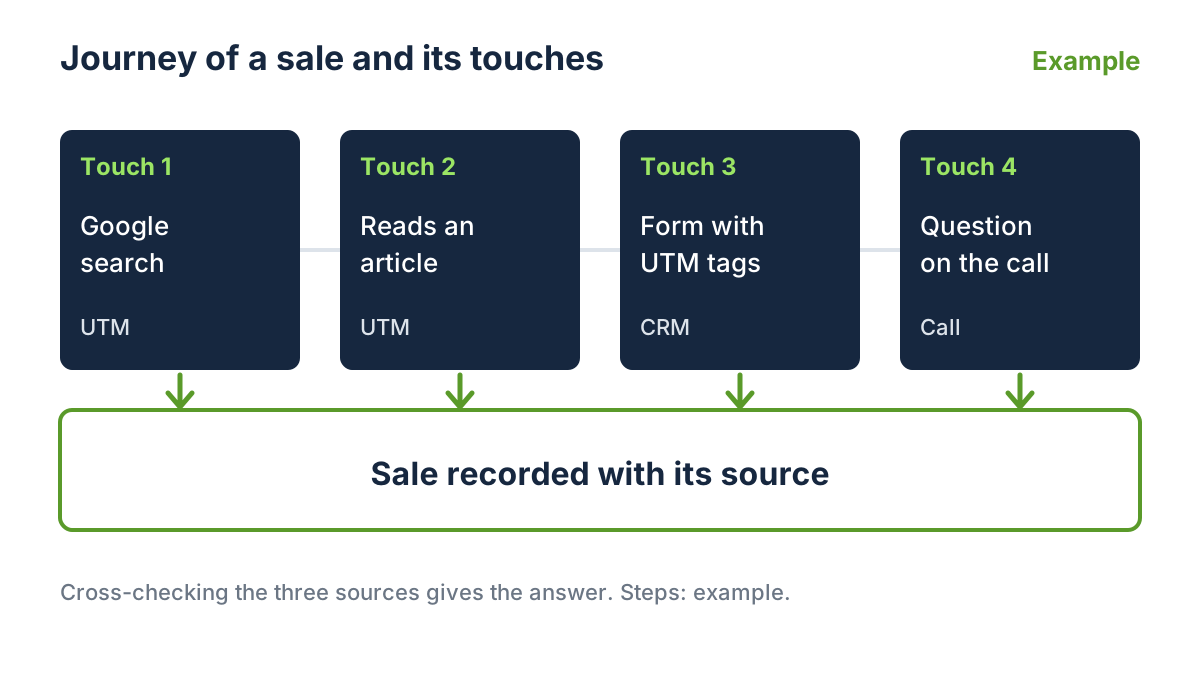 Example: one sale has several touches and each tool records a different one.
Notice that no single tool sees the whole path. UTM-tagged links see the click. The CRM sees the form. The call sees what neither of the others can: what the person remembers. That's why you need all three.
Tool 1: UTM tags on every link you control
A UTM is a piece of text you add to the end of an address so your analytics knows where the click came from. Three parts matter:
- utm_source: which site it comes from (linkedin, google, newsletter).
- utm_medium: what kind of channel it is (ad, email, post).
- utm_campaign: which specific campaign or piece.
You put them on everything you publish and control: ads, emails, posts, your executives' email signatures. They don't work for what you don't control, like when someone recommends you or types your address directly.
Two rules to keep it from turning into chaos. Always write in lowercase, because "LinkedIn" and "linkedin" show up as two different sources. And keep a sheet with the conventions, so whoever publishes next month uses the same names. If Google Analytics feels murky, I wrote a guide in what Google Analytics is.
Tool 2: the source stored in the CRM
A UTM is lost if nobody saves it. Your site's form should copy that data into hidden fields and send it to the CRM along with the name and email. That way, when the contact comes in, the source is already written without anyone typing it.
And the CRM doesn't have to be expensive. It needs, at minimum, a source field that can't be left empty and one rule: the source is recorded when the contact comes in, not later. After three months nobody remembers. I wrote about when to make that jump in CRM for companies: from WhatsApp and Excel to a system.
It's the same reason I insist, in what a lead is, on writing down the source on day one.
Tool 3: the question on the call
This is the cheapest and the most ignored. On the first call, whoever answers asks: "How did you hear about us?" And writes down the answer in the person's own words, not as a category.
It sounds clumsy and it works. It catches exactly what UTMs don't see: a colleague's recommendation, the event, the podcast they heard, the WhatsApp conversation they were already in.
There is a trap. People answer with the last thing they remember, which is almost never the first thing that brought them closer. They say "I found you on Google" when in fact they heard you on a podcast six weeks earlier and then searched for you by name. That's why the call's answer doesn't replace the UTM. They get cross-checked. When both agree, you have certainty. When they don't, you have a lead worth investigating.
How the three cross-check
One sale, three records:
| Source | What it sees | What it misses |
|---|---|---|
| UTM | The click that brought the person | Recommendations and direct visits |
| CRM | The contact's source and progress | What happened before the form |
| Question on the call | What the person remembers | The real order of the touches |
With that you can answer, for each sale, where it came from with reasonable confidence. It isn't perfect. No attribution is. But it's much better than "it came from the website".
For calculating the return on all this, there's how to measure marketing ROI, which uses these same sources.
The heart of the Sísmico Method
All of this sits at the center of what we do. At De Marketing we are the digital marketing department of our clients and we run it with the Sísmico Method: four steps so you know where each sale comes from. Attribution isn't a stage you do at the end. It's the reason for all four steps.
First the terrain is studied. Then the current state is measured. Then we execute with the source recorded from the very first contact. And finally we review which channel produced which sale to decide next month. If the source isn't recorded, the fourth step can't be taken.
The mistakes I see most
Four failures repeat in almost every company:
- Blank or generic source. "Website", "other", "social". Useless for deciding anything.
- WhatsApp contacts never recorded. The conversation started there and never reached the CRM, so the sale shows up as "no source".
- Inconsistent UTM tags. Everyone writes the name their own way and the report fills with duplicate sources.
- Counting only the last touch. If you only credit what came right before the form, Google will always win, even when the podcast or the event started it all.
None requires new software. All of them are fixed with a written rule and someone who checks it every month.
Where to start this week
You don't need a six-month project. This week you can do three things:
- Put UTM tags on the links in your next email and your next post.
- Check whether your form saves the source anywhere. If it only says "website", ask for it to be fixed.
- Write the question "How did you hear about us?" into the first-call script and ask that it be recorded as stated.
In a month you'll have data. In a quarter, a clear picture of which channel brings sales and which only brings visits.
If you want us to set it up with you and leave it running, book your Assessment or look at the Sísmico Method.
Related services
Want to implement this in your company?
Leave your website and within minutes you'll get a reading of your marketing by email: step 1 of the Método Sísmico.
Start your Levantamiento