The Agency Market in Mexico Is Broken
There are over 5,000 registered digital marketing agencies in Mexico. Most operate with the same model: they charge a monthly retainer, send you a PDF with impressions and clicks, and never tell you how much you sold per dollar invested.
It's not that they're bad people. It's that the traditional agency model isn't designed to measure business outcomes. It's designed to measure activity.
If you're a company looking for an agency, you need to filter with different criteria than a business that sells to consumers. Your sales cycle is long, your average deal size is high, and a single client can be worth more than 100 leads.
5 Questions to Ask Before Hiring
1. How do you measure my campaign ROI?
If the answer includes "impressions," "reach," or "engagement" without mentioning CRM, pipeline, or closed sales -- it's a red flag. A serious agency measures from click to sale.
The right answer should sound something like: "We connect your campaigns to your CRM to track every lead from its origin to the closed deal. Your dashboard shows ROI by channel, campaign, and keyword."
2. Will you operate my CRM or just my campaigns?
When selling to companies, campaigns without CRM are like a funnel without a glass. Leads arrive but you don't know where they go, who followed up, or how many became real opportunities.
If the agency only runs campaigns and leaves the CRM to you, you'll have fragmented data. CRM-campaign integration is what enables real ROI measurement.
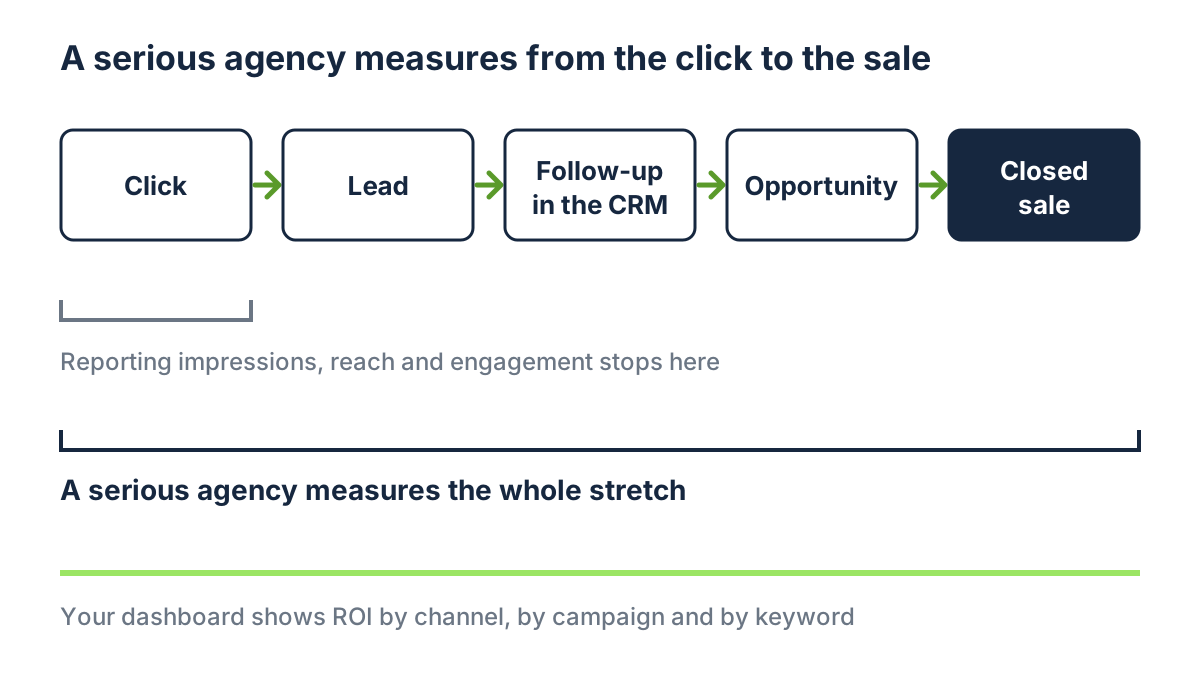 A serious agency measures the whole stretch, from click to sale
3. What's your experience in my industry?
Marketing for a logistics company is completely different from an energy consultancy or a laboratory. Sales cycles, decision-makers, and effective channels change by industry.
You don't need the agency to be an "expert" in your sector, but they must understand dynamics: high deal values, multiple decision-makers, 30-90 day cycles, and the importance of lead qualification.
4. What tools do you use, and who owns the accounts?
Critical point: your Google Ads, Meta Ads, Analytics, and CRM accounts must be under your name. If the agency manages them under their own accounts, you lose all historical data the day you stop working with them.
Also ask about their tech stack. A modern agency should work with:
- Google Ads + Meta Ads (campaigns)
- GA4 + Tag Manager (tracking)
- CRM (Kommo, GoHighLevel, HubSpot)
- Looker Studio or similar (dashboards)
- AI tools for analysis and optimization
5. How long until I see results?
Be skeptical of anyone promising results in 30 days. When selling to companies, a realistic timeline looks like this:
| Phase | Timeline | What to Expect |
|---|---|---|
| Setup | Month 1-2 | Tracking configuration, CRM, initial campaigns |
| Optimization | Month 3-4 | First leads, campaign adjustments, landing page iteration |
| Traction | Month 5-6 | Steady lead flow, enough data to optimize for ROI |
| Maturity | Month 7+ | Optimization based on close data, lower cost per lead, scaling |
Any agency that tells you "guaranteed results in 4 weeks" either doesn't understand business or is lying.
Red Flags: Signs an Agency Isn't Built for Companies
- They propose social media management as a core service. When selling to companies, social media is a credibility channel, not an acquisition channel.
- They never mention CRM anywhere in the proposal.
- They talk about followers and likes instead of qualified leads and pipeline.
- They can't explain what an SQL (Sales Qualified Lead) vs MQL (Marketing Qualified Lead) is.
- Their case studies are restaurants, online stores, or influencers. Selling to businesses is a different sport.
What Agency Model Actually Works for Companies
The model that works for companies isn't the "retainer per service" model. It's the integrated system model: someone who operates campaigns, CRM, and analytics as a single system and reports in business metrics.
This can be:
- An agency specialized in selling to businesses with CRM and analytics capabilities
- A growth consultancy with operational execution
- Internal team + strategic partner that fills capability gaps
What doesn't work is splitting execution: one agency for ads, another for the website, someone internal for CRM, and nobody connecting the data. When the system is fragmented, nobody can measure ROI.
Final Checklist Before Signing
- Does the agency have documented experience?
- Do they connect campaigns with CRM to measure real ROI?
- Are the ads and analytics accounts under my name?
- Do they use AI for optimization and analysis?
- Is the results timeline realistic (5-6 months)?
- Can I see a real-time dashboard, not just a monthly PDF?
- Does the contract allow me to exit if there are no results in 6 months?
If the agency passes all these filters, it's probably worth trying. If it fails more than two, keep looking.
At De Marketing we operate exactly this model: campaigns + CRM + analytics under a single system, with real-time dashboards and measurement through to the sale. Schedule a free diagnostic to evaluate if we're the right fit for your company.
Related services
Want to implement this in your company?
Leave your website and within minutes you'll get a reading of your marketing by email: step 1 of the Método Sísmico.
Start your Levantamiento