
A sales director showed me his Meta report with a look of disappointment: plenty of impressions, plenty of cheap clicks, almost no leads. "Facebook doesn't work for companies," he concluded. I asked him one question: "Where do you think the people who did fill out your Google form last month came from?" He didn't know. A good chunk had seen his ads on Instagram weeks earlier.
That's the core misunderstanding. Meta Ads for companies in Mexico rarely fails because of the platform — it fails because you're measuring it with the wrong yardstick. Below I'll walk through when it works, when it doesn't, and how to measure it right. If you'd rather we set it up for you, we do that; but even if you run it in-house, this guide will help.
When Meta Ads works for companies (and when it doesn't)
The key is understanding the role each channel plays. Google captures demand that already exists: someone searches "payroll software" and you show up. Meta does the opposite — it interrupts someone who wasn't looking for you. That's why judging them by the same metric is a mistake from the start. I unpack it in digital advertising for companies: Meta vs Google vs LinkedIn.
Meta works well when selling to businesses for three things:
- Demand generation and awareness. Putting your category and your point of view in front of the decision-maker before the urgent need shows up. In Mexico, where your buyer lives on Instagram and Facebook even when they're buying for the company, this delivers real reach — cheaply.
- Retargeting. Here Meta is unbeatable. Anyone who visited your site, read a case study, or opened your calculator without converting, you reach again for pennies. It's almost always the most profitable part of the funnel.
- Staying present while they decide. The cycle lasts weeks or months. Meta keeps you top of mind across that stretch without burning your budget.
And when not to use it: if you sell something ultra-niche (your buyers are 200 companies in the whole country), Meta's targeting wastes budget — that's a job for ABM or outbound. If you need high-intent leads this month and have no brand history yet, put the money into Google Ads for companies first. Meta builds; it doesn't close cold.
How to measure it without fooling yourself
The mistake nearly everyone makes: judging Meta by last-click leads. By that yardstick Meta always loses — because its job is to plant, not to harvest. Last-click credit goes to Google or direct traffic, even when Meta started the conversation.
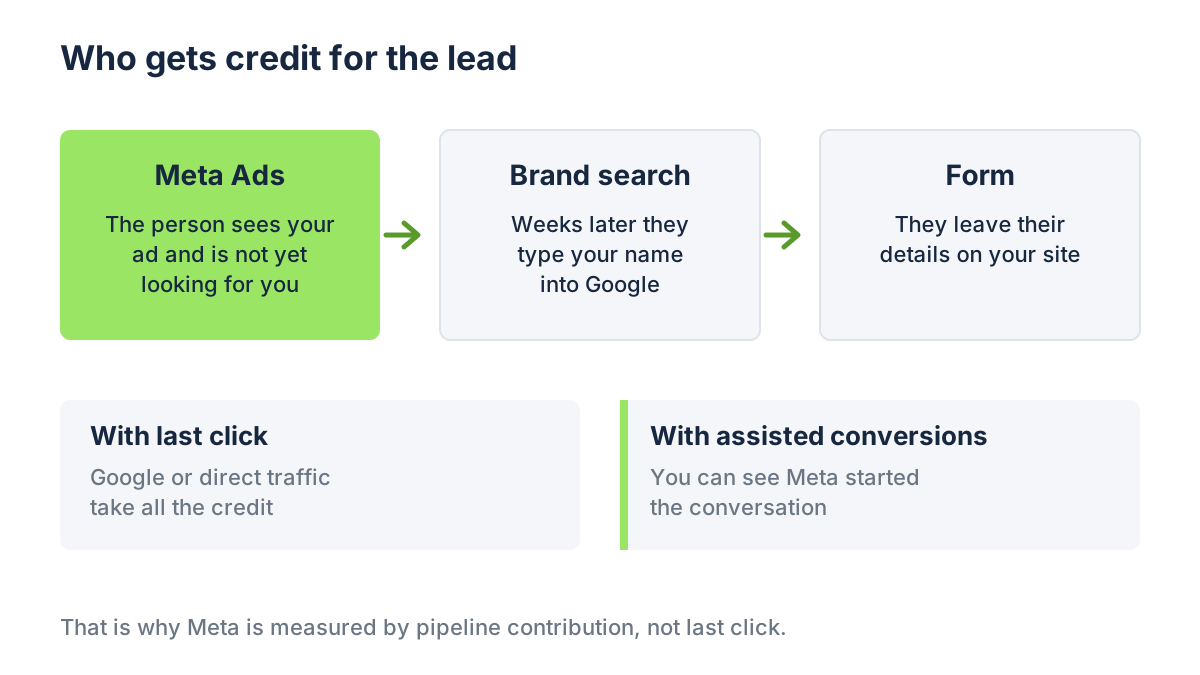 Last click hides Meta; assisted conversions reveal it
These are the metrics that actually tell you the truth:
| What most people measure | What actually decides |
|---|---|
| Last-click leads | Assisted / multi-touch leads |
| Raw cost per lead | Cost per qualified lead |
| Clicks and impressions | Lift in branded search |
| Post "engagement" | Opportunities influenced by Meta |
In practice: track assisted conversions (Meta touched the lead even if it didn't win the click), watch whether your branded searches rise when you turn on awareness campaigns, and calculate cost per qualified lead, not cost per raw lead. A cheaper but worse-qualified Meta lead can cost you more in the end. If that number is exactly your problem, here's how to think about it: lowering your cost per lead.
How we do it
There's no magic and no expensive tool. It's honest measurement wired end to end, and in the Seismic Method it's the first thing we set up:
- First-party source capture on the site: every visit is tagged with its channel and campaign, and that data travels with the prospect all the way to the form — without leaning only on the pixel or third-party cookies that barely last anymore.
- Everything lands in a CRM, not a spreadsheet. The lead is born tagged, and if it touched Meta before converting through another channel, that's on record.
- n8n automation to close the loop: when the contact advances or signs, we can see the full chain and say "this started with an Instagram ad back in March."
That's how we stop arguing about whether Meta "works" and start seeing the role it actually plays inside the system.
How we help
If you don't want to spend months wiring up the pixel, the CRM, and multi-touch attribution, that's exactly what we do: we build the full measurement setup so you can see Meta's real contribution — assists, brand lift, and cost per qualified lead — not just the last click. Book a diagnostic and we'll review it with your numbers.
The bottom line
Meta Ads when selling to businesses is neither good nor bad: it's one piece. Judging it by last-click leads is like blaming the player who made the first pass for not scoring the goal. Set it up for what it's good at — demand, retargeting, presence — and measure it by its real contribution to the pipeline.
Want to know what each channel is truly contributing in your business? Book a diagnostic, no strings attached and we'll look at it with your numbers, not ours.
Related services
Want to implement this in your company?
Leave your website and within minutes you'll get a reading of your marketing by email: step 1 of the Método Sísmico.
Start your Levantamiento