

A sales director showed me his CRM on a screen in the boardroom. They had paid for the license eight months earlier. He opened the opportunity board and there were eleven, for a team of seven reps. I asked how many sales they had in progress. "About forty," he said. The other twenty-nine lived in WhatsApp and in each rep's head. The CRM hadn't failed. The team had let it die quietly, which is the most common way.
If you want to implement a CRM without your team abandoning it, the work isn't in the tool. It is in four weeks of decisions almost nobody makes before adding the users. Here is why it gets abandoned and the 30-day plan I use. If you haven't chosen a tool yet, read the best CRMs for companies in Mexico first.
Why reps stop using the CRM
Nobody abandons a CRM out of laziness. They abandon it for fairly logical reasons, and it is almost always these:
- It costs them work and gives nothing back. The rep logs so the director can see reports. They get nothing in return. If the CRM doesn't save them at least one step, it is one more chore.
- There are too many fields. Twenty-two required fields per prospect is a sure way to get garbage or a surrender.
- Nobody uses it upstairs. If the director keeps asking for sales status by WhatsApp or in a spreadsheet, the message is clear: the CRM is decorative.
- They feel watched. When the first use of the report is to scold someone, the team learns not to log what is uncomfortable.
- Nobody taught them. A two-hour training on day one is forgotten within a week.
From that list comes the principle of the whole plan: the CRM has to help the rep first and the director second. In that order. If you flip the order, the team notices.
The 30-day plan
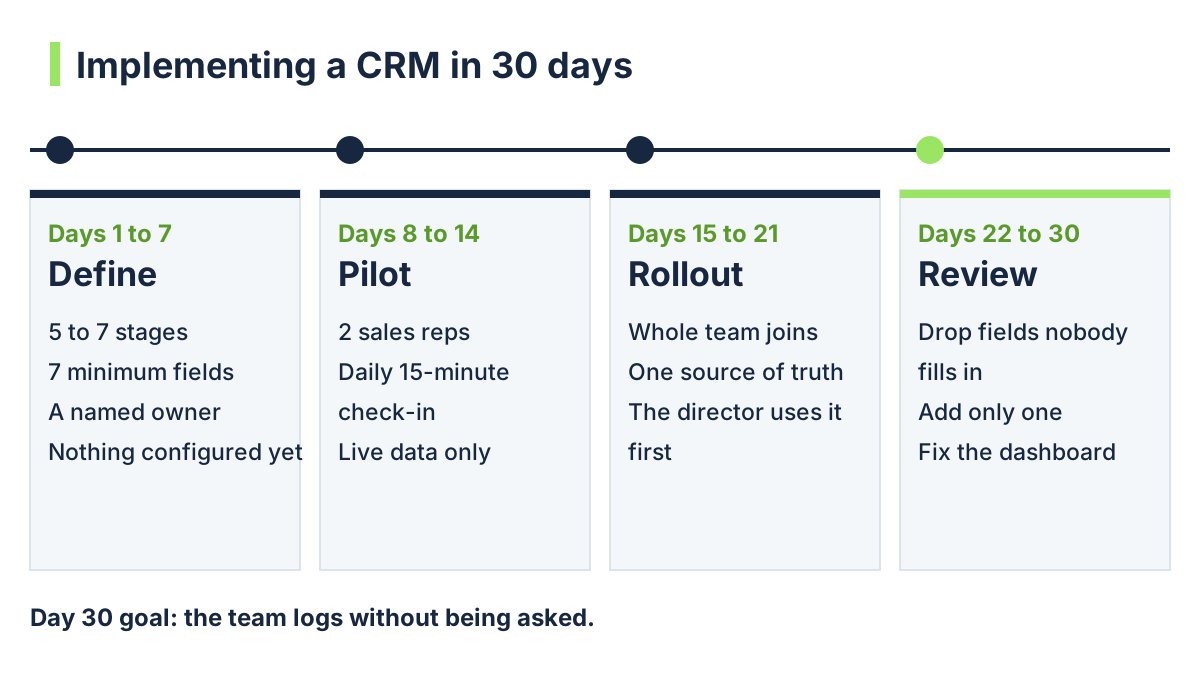 Implementing a CRM in four weeks: what happens in each one
Week 1: define before you configure
Don't open the tool yet. First, on a sheet of paper or a whiteboard, write down three things:
- The stages of your sale, between five and seven, each with a one-line definition. "Quoted" means the customer has a document from you with a price, not that you chatted with them.
- The minimum fields: the ones you really use to decide. Name, company, phone, prospect source, stage, next step and date. With seven fields you can operate. The rest are added later, one by one, if someone shows they need them.
- The CRM owner: one person with a name who decides changes and answers questions. Without them, the system fills up with fields within three months.
If your pipeline still isn't clear, the sales pipeline and its metrics helps you define the stages.
Week 2: pilot with two people
Configure the CRM with what you defined and give it to two reps, one enthusiastic and one skeptical. The skeptic is more valuable: if you convince them, you convince everyone. Ask them to log every call and every quote for a week, and meet with them for 15 minutes a day. Write down everything that gets in their way and fix it the next day.
This week you also import the old data, but only what is useful: active customers and open opportunities. The contacts from three years ago in a sheet with no owner stay out, because a CRM that starts with 5,000 junk records is born dead.
Week 3: rollout to the whole team
With the pilot's adjustments, the rest come in. Two rules that work:
- A single source of truth. From this Monday on, if it isn't in the CRM, it doesn't exist. What was agreed on WhatsApp gets logged there at the end of the day.
- The director uses the CRM first. In the weekly meeting the board is projected and you talk about what appears there. The parallel spreadsheet is over.
That is what the pilot is for: the two pilot reps teach the others with their own cases. Learning from a colleague carries more weight than vendor training. Meanwhile, take care of the channel where most selling happens: if your customers write to you on WhatsApp, see WhatsApp Business for sales to connect those conversations and not lose them.
Week 4: review and cut
On day 30 there is a one-hour meeting with three questions:
- Which field does nobody fill in? It gets removed or made optional.
- Which piece of data are we missing to decide? One gets added.
- Which report was actually useful this week? It becomes the main board.
This meeting is what prevents slow abandonment. A CRM that adjusts every month to what the team lives doesn't feel imposed.
Three things not to do
Promise that the CRM will take work off them in the first month. It isn't true. The first month costs a little more, because logging is a new habit. Say it straight and show what they recover by month three: not hunting through old chats, not losing a quote, not getting scolded for something they did do.
Pay commission only on what is in the CRM without warning. Some directors decide that only what is logged gets paid. It is a good rule, but it is announced a month ahead and after the system already works. If it applies from day one, you punish the people who are still learning.
Leave the configuration to a consultant with nobody from the team involved. A law firm in Monterrey told me its implementer delivered a flawless system that nobody wanted to open. The reps never saw how it was built or why each field was there. A tool is explained better when someone on the team helped build it.
What you measure to know it is going well
Don't measure how many users are registered. Measure three things and look at them every Monday:
- Percentage of opportunities with a next step and date. If it drops below 80%, there are holes.
- Days without contact for each open opportunity.
- Percentage of prospects with the source captured. It is the figure that later tells you which marketing channel brings sales and which only brings messages.
If the CRM captures well, it serves marketing and sales equally. On how to connect that system with demand generation, alignment between marketing and sales completes the picture.
When to ask for help
If your team has more than ten reps, if you have several sales processes or if you already failed one implementation, it is worth having someone external accompany you through those four weeks. Not to configure the tool, but so that the week-one decisions get made and stick.
At De Marketing we are our clients' digital marketing department and we run it with the Método Sísmico, four steps so you know where each sale comes from. A CRM the team really uses is where that source gets recorded. If you want us to build it with you, start with the Levantamiento.
Related services
Want to implement this in your company?
Leave your website and within minutes you'll get a reading of your marketing by email: step 1 of the Método Sísmico.
Start your Levantamiento