
The sales director of a services company in Mexico City told me something I hear often: "We pay the same on Google as a company four times our size, and they always come out on top." She was right about the first part. In Mexico City everyone competes for the same clicks, and the companies with the most budget raise the price for everyone.
That is the reality of digital marketing in Mexico City: more competition, pricier clicks and buyers who receive twenty proposals a week. It is not solved by spending more. It is solved by spending better and picking battles you can win. Below I explain how. And if what you want is someone to run it for you, that is on the digital marketing in Mexico City page; this guide is the how-to.
Why Mexico City is different from other markets
Three things change when you do marketing in the capital:
- More sellers for every search. Almost any service you sell has dozens of competitors buying the same keywords. That raises the click price. I give no figure because it changes by industry and by month; check it in the Google Ads Keyword Planner with your own terms.
- Your buyer gets a lot of noise. They are used to discarding generic messages. What stops them is precision: speaking about their problem in their words.
- The city is huge and your customer is not. Serving the whole metro area with one message is waste. A company in the Santa Fe area does not buy the same way as one in the north or the center.
The practical consequence: mass reach becomes expensive and unprofitable. The advantage is in tight segmentation.
The priority order I would follow
Do not start with the flashiest channel. Start with the order that protects your money:
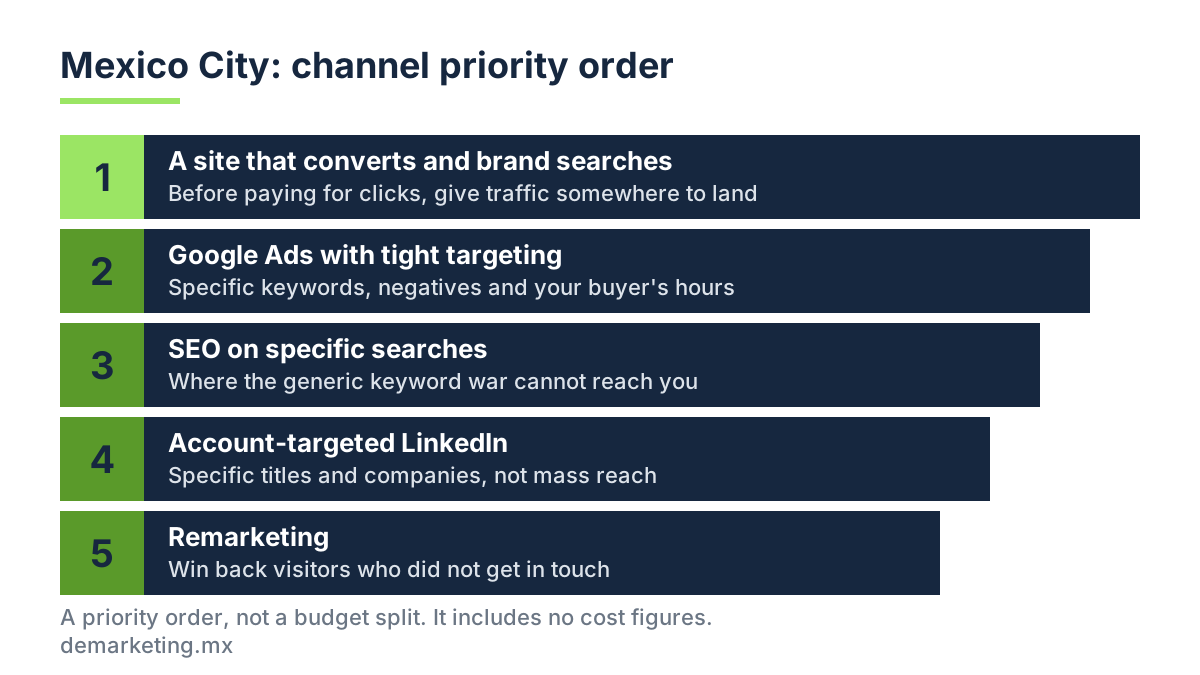 Channel priority order for a mid-sized company in Mexico City
It is a priority order, not a budget split. Here is why it goes in that order.
1. A site that converts, before paying for clicks. When clicks are expensive, every visit that leaves without writing weighs more. Before raising spend, check that your pages match what the ads promise, that the form is short and that the phone and WhatsApp work. This is where landing pages that generate leads come in.
2. Google Ads with tight targeting. Instead of buying "consulting" or "logistics services," buy the specific phrase your buyer types, add negatives to cut traffic that is not yours and schedule ads for the hours your customers work. An expensive click is fine if the right person receives it. To understand the math, see how to reduce cost per lead.
3. SEO on specific searches. Competing for the generic keyword against the city's biggest companies is a lost fight. Long, concrete searches are cheaper to win and bring buyers with more intent. If you hesitate between paying and ranking, read SEO vs Google Ads.
4. Account-targeted LinkedIn. Mexico City concentrates headquarters and purchasing departments of many companies. That makes targeting by title and company make sense. It costs more per click, so use it with a short list, not for general reach. Details are in LinkedIn Ads in Mexico.
5. Remarketing. It is almost always the most profitable channel in the funnel, because you speak to someone who already knows you. When traffic is expensive, winning back the people you already paid to bring in is the first thing to protect.
How to stand out when you are not the biggest
There is no trick. There are five concrete decisions:
- Pick a niche and say it. "Manufacturers that export" beats "companies in general." When your site says who you serve, the right buyer recognizes themselves.
- Show verifiable proof. Cases with context, certifications, years in operation. No adjectives. A buyer in the capital has seen a thousand "we are leaders."
- Respond fast. In a city with this much supply, the first to reply usually wins the conversation. If a form takes a day to get an answer, you already lost.
- Give each page one action. One page, one goal. When there are three different buttons, none gets clicks.
- Measure by opportunity, not click. With expensive clicks, cost per qualified lead is the only figure that matters. A cheap lead who never answers costs more than an expensive one who closes.
An anonymous example, no figures: a services company in the capital spent its budget on broad keywords and got requests of every kind, most outside its profile. After switching to specific phrases with negatives and one landing page per service, request volume dropped, but the ones that arrived were the right ones, and the sales team stopped losing time filtering. Fewer leads, more sales. That is the kind of move that works in an expensive market.
Mistakes I see often in the capital
- Copying a bigger company's strategy. Their budgets and brands let them play at another scale. You win on precision.
- No negative keywords in Google Ads. In a city with this much traffic, without negatives you pay for clicks from the curious, students and competitors.
- Serving the whole city the same way. Segment by area, by type of company and by hour.
- Reporting visits and not opportunities. If the report does not say how many sales conversations came out, it tells you nothing.
- Forgetting source tracking. If the CRM does not record which channel each contact came from, you cannot decide where the next peso goes.
Questions I get in meetings
How much should I pay for a click? There is no right number. What matters is what a qualified lead costs and what a customer is worth. If an expensive click brings the right person, it ends up cheaper than a hundred cheap clicks from the curious. For the full math, see customer acquisition cost.
Should I leave Google and move to social media? Rarely. If your buyer searches for you on Google, that is where the intent is. Social media helps build presence and supports remarketing; it is not a substitute for capture.
How long until the change shows? Targeting adjustments in Google Ads show in weeks, because the system learns fast. SEO and brand reputation take months. That is why it pays to combine both timelines rather than bet on one.
How do I know whether my agency or team is doing it well? Ask them to show how many sales opportunities came from each channel, not how many clicks or impressions. If they cannot tell you, measurement is missing. To see how to evaluate a report, read why your agency is not giving you ROI.
What to take away
In Mexico City the winner is not who spends more, but who reaches the right person with the most precise message and knows how to measure what each peso brought. At De Marketing we do that as the digital marketing department of our clients, with the Sismico Method, four steps so you know where each sale comes from.
If you want to review how you compete today and what you would adjust first, schedule a Levantamiento (our discovery session). We do it with your numbers, no commitment.
Related services
Want to implement this in your company?
Leave your website and within minutes you'll get a reading of your marketing by email: step 1 of the Método Sísmico.
Start your Levantamiento