
The owner of a nine-person services company wrote to me. She wanted to know whether she should "get a CRM". I asked what they used today. A shared Excel sheet, three WhatsApp groups and the notebook of one saleswoman who didn't trust the sheet. I asked how much time they lost looking for a piece of data. "About an hour a day, all of us together," she said. I did the math out loud and she realized on her own that she was already paying for a CRM. She was just paying it in her team's hours.
The free or paid CRM question isn't settled with a feature list. It is settled with concrete signals from your operation. Here are the ones I use. If you are just starting to understand what this is, begin with what a CRM is; if you already want to compare tools, the best CRMs for companies in Mexico has the table.
When a free CRM is enough
A free CRM is enough more often than software vendors want you to believe. Free tiers almost always give you contacts, companies, a deal board, call and email logging, and some basic reports. For that, it is plenty as long as these conditions hold:
- One to three reps. Everyone knows everything without needing permissions, flows or roles.
- A single sales process. A short list of stages, the same for everyone.
- Few leads a month. If you can count them on your hands, volume is not the problem.
- Follow-up lives in email. You don't depend on WhatsApp to close.
- You still don't know how you sell. And this matters: using a free tool to discover your process is an excellent zero-peso investment.
At that stage, paying too much is a way of postponing the real work, which is writing down your stages and deciding who answers what.
The five signs it is time to pay
These are the ones I see in meetings. With two or more, the free plan is already costing you more than it saves.
1. You have more than three or four reps. Questions start to appear about who saw whom, who distributes prospects and who sees whose accounts. Free plans have almost no permissions or assignment rules.
2. Your customers write to you on WhatsApp. In Mexico, a lot of selling closes there. If the conversation lives on each rep's personal phone, it leaves with them when they quit. Connecting WhatsApp to the CRM is usually a paid feature or needs an additional connector; confirm with each vendor before deciding. I wrote about organizing that channel in WhatsApp Business for sales.
3. You need reports the plan doesn't give. If you want to see the source of each sale, the time between stages or what each rep closes per month, and the free plan limits it, you have hit the ceiling. A report that costs you an afternoon of copying and pasting into Excel counts too.
4. You have integrations to maintain. The website form, the ads, the email tool, invoicing. When each one is connected by hand, a piece of data always gets lost, and it is almost always the lead's source.
5. You need the system to work on its own. Follow-up reminders, automatic assignment, alerts when a prospect returns to the site. Automation is almost always the first thing reserved for paid tiers, and it is what saves the most time.
A simple rule to decide
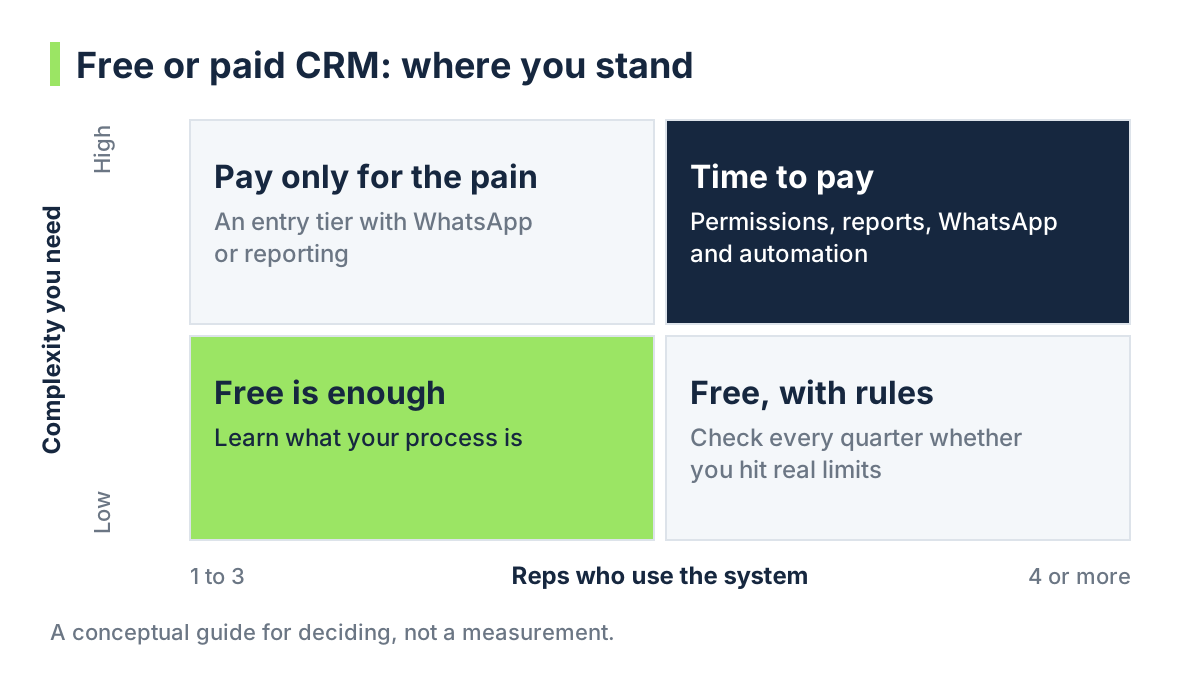 Where you stand based on your team and your needs
The matrix crosses two things: how many reps use the system and how much complexity you need (WhatsApp, reports, integrations). Bottom left, free is enough. Top right, paying is the sensible call. The other two boxes are the uncomfortable ones: few reps with a lot of need, or many reps with little. There the criterion is what hurts most today.
Do the math on the hours
A quick test, with hypothetical numbers you swap for your own. Suppose a six-person sales team where each person loses 20 minutes a day looking for a piece of data, asking about the status of a quote or rebuilding a conversation. That is two hours a day across the team, about 40 hours a month. Multiply those hours by what an hour of your team costs and you have the monthly cost of not having an orderly system.
Now compare that figure with the per-user license of the tier you are considering, which you can request in writing. If the license costs less than the lost hours, paying is already good business, even if nobody wrote it down anywhere. If it costs more, stay free and fix the process first.
This math leaves out the most expensive part: the sale that went cold because nobody followed up in time. It doesn't show up on any sheet, but the director recognizes it the moment I mention it.
What staying on free too long costs you
A cost nobody adds up is the cost of migrating late. If you stay on the free plan for two years and arrive with 6,000 badly captured contacts, every duplicate and every misspelled field migrates with them. Migrating late means cleaning first and switching after, and that takes weeks.
The second cost is trust. When the CRM doesn't answer what the director asks, the team gets used to not using it, and recovering the habit is much harder than building it. On that, see how to implement a CRM without your team abandoning it.
What is worth paying for first
When you finally decide to pay, not everything in the higher tier is worth the same. My priority order, from what returns most to what returns least:
- Permissions and assignment. Each rep sees their own and new prospects get distributed without fights.
- Reports with the source of each sale. Without that, marketing spend stays in the fog. On how to get to that figure, how to measure marketing ROI.
- WhatsApp integration. If that is where you sell, that is where your operation lives.
- Follow-up automation. What you forget, the system remembers.
- Everything else. Signatures, artificial intelligence, service modules. Later, and only if you are using it.
Before signing, ask in writing what the price includes at your real number of users and what each extra module costs. And ask how you export your data if you decide to leave.
Where marketing comes in
At De Marketing we are our clients' digital marketing department and we run it with the Método Sísmico, four steps so you know where each sale comes from. That source is the main reason I recommend my clients have a CRM that captures it from day one, free or paid.
If you want us to review together which side of the matrix you are on and what to do this quarter, start with the Levantamiento.
Related services
Want to implement this in your company?
Leave your website and within minutes you'll get a reading of your marketing by email: step 1 of the Método Sísmico.
Start your Levantamiento