
A director at a services company told me in a meeting: "My site gets two thousand visits a month and almost nobody writes in. I need more traffic." I asked how many contacts came in. Forty. I told him the problem might not be traffic. With the same two thousand visits you can get sixty contacts if the site does its job better, and that costs less than buying a thousand more visits.
That ratio is called the conversion rate, and it's the number that changes a website's results fastest. Here I explain what it is, how to calculate it with an example and what raises it. If you'd like us to review it with your site's data, book your Assessment.
What conversion rate is
It's the percentage of visitors who do what you want them to do. That "what you want" is called a conversion, and you decide which one it is: filling out the form, writing on WhatsApp, requesting a quote, booking a call.
The formula is short:
Conversion rate = conversions ÷ visits × 100
If a hundred people visit your site and two request a quote, your conversion rate is 2%.
What almost nobody clarifies is that there's more than one rate on the same site. Visit to contact, contact to sale and visit to sale are three different numbers, and each tells a different story. Mixing them up is behind most arguments between marketing and sales.
How to calculate it, with an example
The numbers that follow are an example, made up to show the calculation. They aren't an average of anything or a target.
Suppose a services company's site had this in one month:
- 2,000 visits.
- 40 contacts (forms and WhatsApp messages).
- 8 closed sales from those contacts.
Then:
| What you calculate | Operation | Result |
|---|---|---|
| Visit to contact | 40 ÷ 2,000 | 2% |
| Contact to sale | 8 ÷ 40 | 20% |
| Visit to sale | 8 ÷ 2,000 | 0.4% |
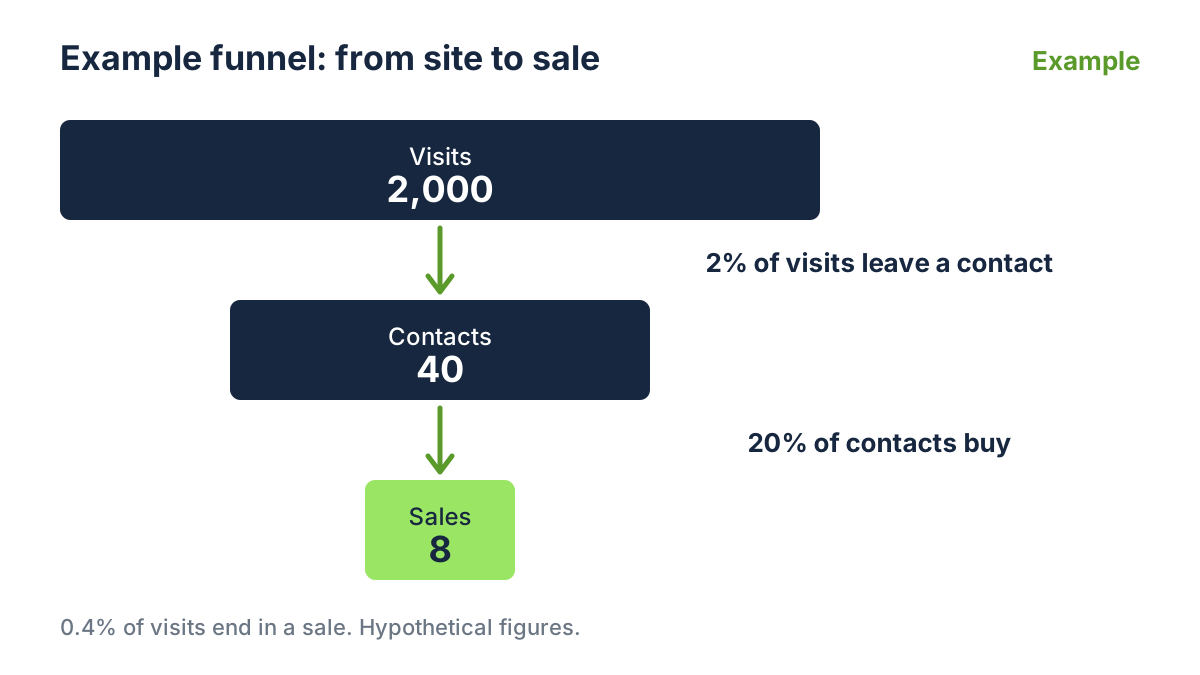 Example: of every 100 visits, 2 leave a contact, and of every 100 contacts, 20 buy.
Those three rates tell you where the problem is. The first depends on the site. The second depends on the sales process. The third mixes both and so, alone, explains nothing.
What happens if you raise the rate instead of the traffic
With the same example, imagine you improve the site and the visit-to-contact rate goes from 2% to 3%. Everything else stays the same:
- Visits: 2,000 (no change).
- Contacts: 60 (3% of 2,000).
- Sales: 12 (if the 20% contact-to-sale rate holds).
That's four more sales a month without paying a peso more for traffic. To get the same result at the original 2% rate, you'd have had to raise traffic to 3,000 visits, and that does cost money.
I'm not saying going from 2% to 3% is easy or automatic. I'm saying the math is there so you can decide where it pays to push. I wrote about what to measure and how in digital marketing KPIs.
What counts as a good rate
People ask me for a figure here and I'd rather not give you one from memory. The rate depends on the industry, the price of what you sell, which conversion you measure and the traffic source. A quote form for something high-value converts far less than a free download, and that doesn't make it worse.
The useful comparison is with yourself: this quarter's rate against the last one, by channel. A site whose rate climbs month after month is doing well, even if the number looks small.
What raises the conversion rate
These are the levers I check first, in the order they tend to pay off.
1. A message at the top that can be understood in five seconds. Whoever arrives must know what you sell, for whom and what comes next. If they have to scroll to find out, they've already left. Review what the visitor sees before scrolling.
2. One main action per page. When a page asks people to call, subscribe, download and follow you on social media, they do none of them. Pick the action that matters most and make it obvious.
3. A short form. Every extra field lowers the rate. Ask for the minimum needed to reply: name, email or phone, and a line about what they need. The rest gets asked on the call.
4. Proof that you're real. Cases with explained results, the name of whoever runs the company, city, visible contact details. For a mid-sized company, fear of choosing the wrong supplier holds buyers back more than price does. More on that in case studies and testimonials.
5. Speed and mobile. A site that loads slowly or looks bad on a phone loses people before they read anything. It's among the cheapest things to fix and among the most ignored.
6. Pages built for a single search. A page that answers exactly what the person searched for converts better than a generic one. That's what landing pages that generate leads do.
If your site already gets visits and doesn't convert, there's a list of common faults in why your website doesn't sell.
How to improve it without guessing
Changing the site by gut feel is the most expensive way to learn. The order I recommend:
- Measure first. Define what a conversion is and make sure it's recorded correctly. If the measurement is broken, any improvement is a bet.
- Change one thing at a time. If you change the headline, the form and the colors on the same day, you won't know what worked.
- Wait for enough data. With few visits, a change "wins" by chance. It's better to let it run for several weeks.
- Split by channel. Search, ad and email traffic behave differently. A global average hides where the leak is.
This discipline is called conversion rate optimization, and it's a full service with its steps laid out in CRO.
A common mistake: looking only at the average
A site rarely converts the same on every page or with all its traffic. Visits that arrive through a search from someone who already wants a quote tend to convert far more than those coming from a social post. If you average everything, you see a lukewarm number that tells you neither which channel works nor which page fails.
That's why, when I review a site, I split the rate by traffic source and by entry page. Almost always the same thing appears: one or two pages that concentrate the conversions and several that receive visits without converting anything. That's where the work is.
Closing
Conversion rate is the part of marketing where a small change shows up in next month's sales. But only if you know which of the three rates you're moving and if every contact is recorded with where it came from.
At De Marketing we are the digital marketing department of our clients, and we start every relationship with an Assessment that reviews, among other things, how much your site converts and where people drop off. If you want that diagnosis, book your Assessment or see the Sísmico Method.
Related services
Want to implement this in your company?
Leave your website and within minutes you'll get a reading of your marketing by email: step 1 of the Método Sísmico.
Start your LevantamientoRelated articles