
A commercial director at a distribution company showed me her dashboard in our first meeting. She had the website form, three search campaigns and a weekly email. "My leads are covered," she told me, "but every month there are fewer." I asked her how many people in her market knew her company existed. She paused for a long time. She didn't know, and nobody had ever measured it.
That is the most common blind spot I see. Demand generation gets confused with lead generation, all the money goes to the second one, and the first is expected to happen on its own. Here I explain the difference, how the two fit together and in what proportion to mix them depending on your company's stage. If you'd rather we review it against your operation, book your Assessment.
What demand generation is
Generating demand means getting the right people to know you exist, understand which problem you solve and remember you when they need it. It doesn't ask for anything yet. No form, no quote. Just recognition.
It's done with useful content, a presence on LinkedIn, video, podcasts, events, reach ads and a website that explains what you sell. Results are slow and hard to credit to any single action. That's why it's the first thing cut when the budget gets tight.
Demand doesn't show up in a weekly report. You notice it months later, when someone writes in and says "I found you because I keep seeing you everywhere."
What lead generation is
Generating leads means catching the people who already have the need and are raising their hand. Here there is a form, a call, a WhatsApp message, a quote. If you're not sure what counts as a lead, I wrote about it in what a lead is and why a qualified lead is not a sale.
It's done with Google search, landing pages, clear forms, follow-up emails and a fast response from sales. Results are quick and easy to measure: how many came in, from where and what each one cost.
The catch is that capture only collects what already exists. If the market doesn't know you, nobody raises a hand, no matter how much you optimize the form.
Two layers of the same system
Think of it as two layers. On top is demand: it creates interest and memory. Below is capture: it turns that interest into a sales conversation. Each one without the other fails in a different way.
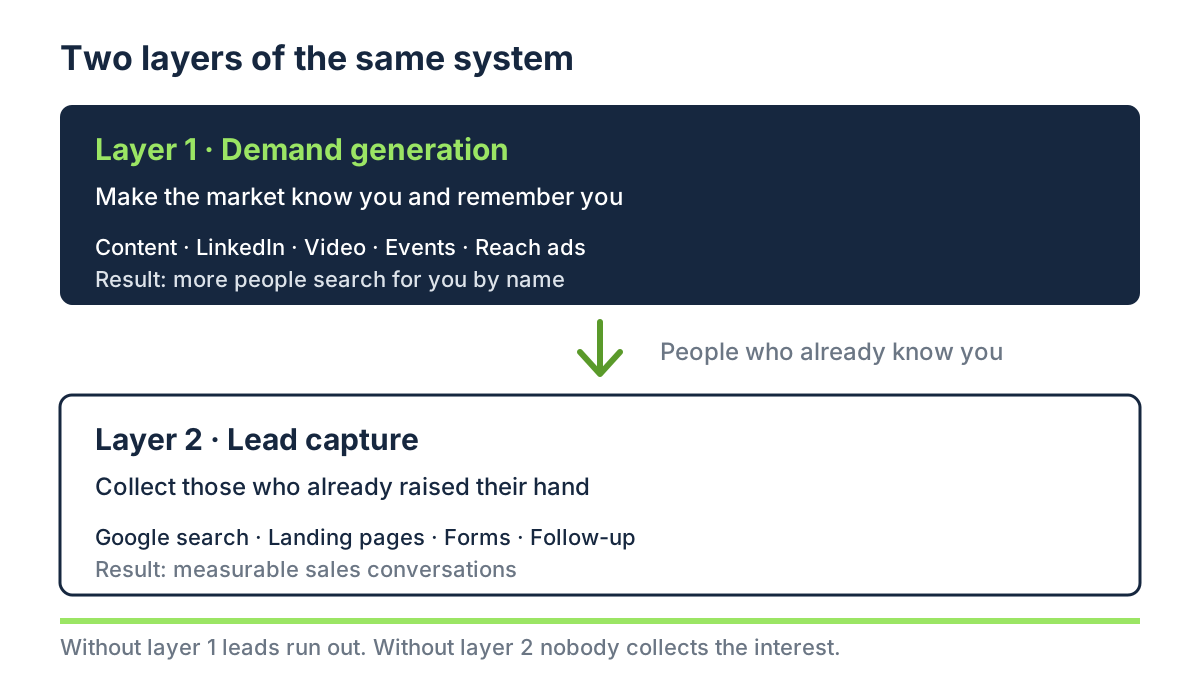 Two layers of the same system: demand creates interest and capture collects it.
| Demand generation | Lead generation | |
|---|---|---|
| Question it answers | Do they know I exist? | Who wants to talk now? |
| Who it speaks to | Your whole market, even if they aren't buying yet | People who already have the need |
| What you measure | Reach, brand searches, direct visits | Leads, cost per lead, quality |
| Speed | Months | Weeks |
| Risk if you neglect it | Leads get expensive and dry up | Nobody collects the interest you created |
The relationship between the two explains something almost nobody says out loud. When cost per lead climbs for no clear reason, it's often not the ad that failed. The demand underneath dried up because you stopped sowing above. For how that shows up in a number, see how to reduce cost per lead.
What happens when you do only one
Capture only. This is the distribution director's case. All the effort goes into Google and the form. It works as long as people are searching. But you compete with everyone else on every search, cost per click rises, and your brand adds nothing because nobody recognizes it. It's an operation that depends on paying for every single contact.
Demand only. The opposite case, and I see it in companies that publish a lot of content but have no clear path for the person reading it. There's an audience, there's applause, and sales don't move. The bottom layer is missing: a site that converts, a clear offer and someone who answers the same day.
The result of either one alone is the same: a good month, a bad month, and no way to explain the difference. I go deeper in the demand system, where I turn the idea into concrete pieces.
In what proportion: it depends on your stage
There's no universal ratio. It changes with how well known your company is and how fast you need results. What follows is a working criterion, not a formula, and we adjust it with each company.
A company that is starting out or entering a new market. Almost nobody knows you. Capture pays little here, because few people are searching for you. But you can't wait a year for demand to mature either. The sensible path is to start with capture on the searches that already exist so sales come early, and set aside a real share of the effort so the market learns who you are. The mix tilts toward demand once basic capture is working.
An established company that lives on referrals. It has a good reputation but an irregular flow. Capture is what's missing: so that someone who hears about you can find you, understand your offer and write to you. The demand already exists; it just isn't being collected. Investment tilts toward capture, and it's worth reading how to stop depending on referrals.
A company that is already growing and wants to sustain it. Capture works and cost per lead is starting to rise. This is the moment to invest at the top again, in content, video and presence, before the bottom layer runs out. It's what gets done least and costs most later.
Notice that I never say "only". Every stage has some of both. What changes is which one weighs more.
How to tell which one you're missing
Three questions are enough for a first diagnosis:
- How many of the people who write to you already knew you? If almost all arrive cold, about to compare five suppliers, you're missing demand.
- How many of your visitors end up leaving their details? If there are many visits and few contacts, you're missing capture.
- Can you say where each sale this quarter came from? If not, you don't know which layer is working. I wrote about this in the sales funnel.
With those three answers you know where to start. Without them, every budget decision is a coin flip.
An anonymous example
A law firm in Monterrey lived on referrals and one search campaign. When referrals dropped, the campaign couldn't cover the gap, because searches for their service were few and shared with other firms. The problem wasn't the ad. For years they had sown nothing that would make anyone search for them by name.
The fix wasn't spending more on the campaign. It was publishing, for several months, explained cases and answers to their clients' doubts, and measuring how many people arrived searching for the firm's name. That figure became their demand thermometer, and the search campaign started paying off again because it was no longer alone.
Closing
Demand generation and lead generation don't compete. They are worked in different proportions depending on your company's moment, and both have to be measured with the same rule: where each sale came from.
At De Marketing we are the digital marketing department of our clients, and we always start with an Assessment: we review which layer you have, which one you lack and how much of your investment sits in each. If you want us to do it with your company, book your Assessment or see how we work in the Sísmico Method.
Related services
Want to implement this in your company?
Leave your website and within minutes you'll get a reading of your marketing by email: step 1 of the Método Sísmico.
Start your Levantamiento